
Active prep about 45 minutes · Bulk ferment 4 to 5 hours · Cold proof 12 to 16 hours · Bake 45 minutes · Makes 1 loaf
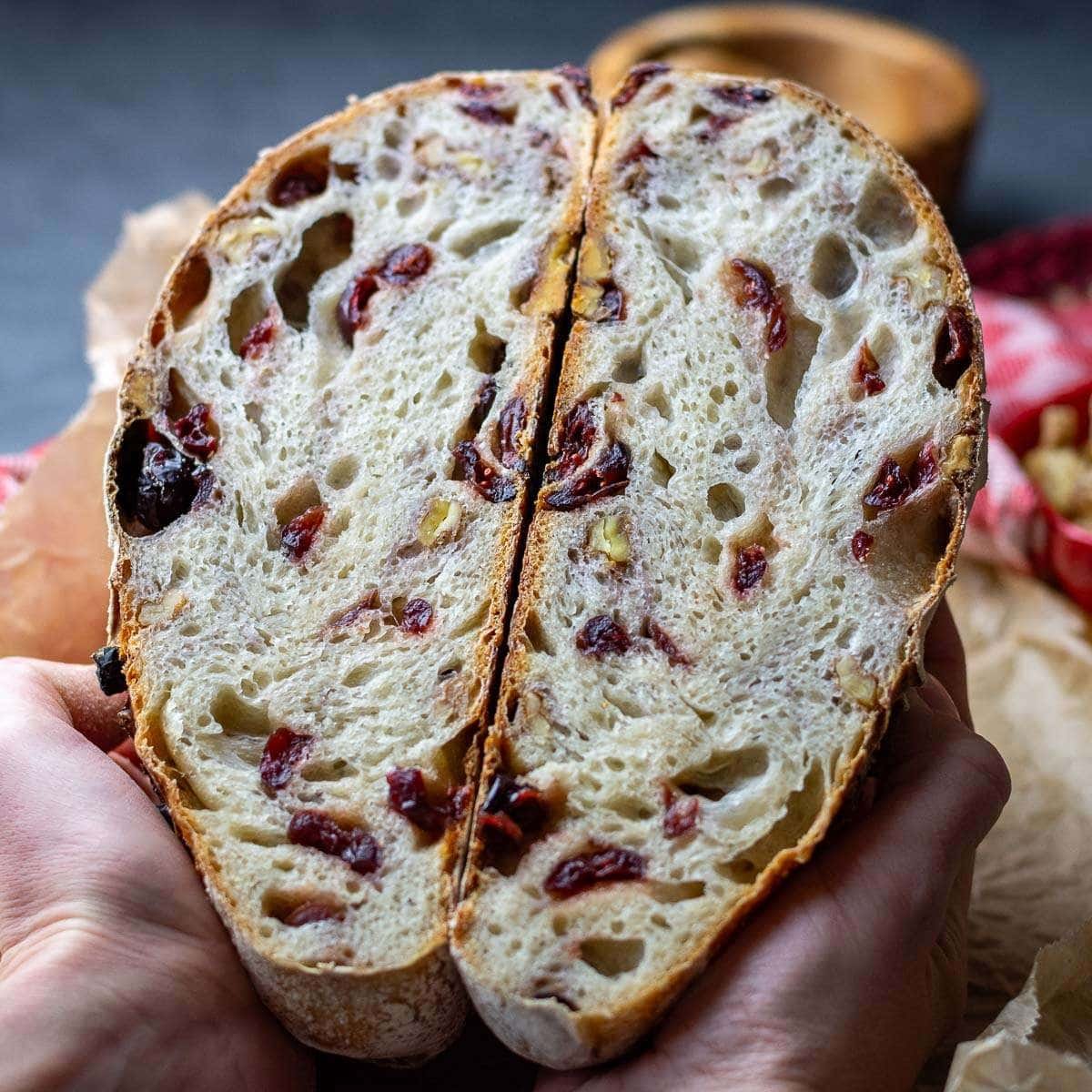
Tart cranberries, buttery walnuts and a whisper of cinnamon in a naturally leavened loaf. The add-ins go in at the end of bulk so the crumb stays open and the nuts keep their bite. It toasts beautifully and makes an exceptional turkey sandwich.
A SHORT HISTORY OF FRUIT AND NUT BREADS
Putting fruit and nuts into bread is older than the loaf tin. Roman bakers worked dried fruit and nuts into panis, and medieval European bakers built whole traditions on it, from German stollen to Italian panettone. The purpose was practical before it was festive: dried fruit and nuts were calorie dense, kept well, and turned a plain daily bread into something that could carry a journey or a feast.
Cranberries are the American contribution. They grow wild in the bogs of New England and were used by Indigenous peoples long before colonists arrived, dried and pounded into pemmican with fat and meat. Pairing them with walnuts in a sourdough loaf is a modern idea, but it follows the same old logic: something tart, something rich, and a bread sturdy enough to hold both.
WHY THE ADD-INS GO IN LAST
Walnuts and cranberries are heavy, and they fight the dough in different ways. Nuts have sharp edges that tear the gluten strands you have spent hours building. Dried cranberries are hygroscopic, meaning they pull water out of the dough and into themselves, which stiffens the crumb around them.
Folding both in at the end of the bulk rise sidesteps all of it. The gluten network is already developed, so the nuts cannot shred it, and the cranberries have less time to rob the dough of moisture. A gentle laminate and two folds is enough to distribute them evenly without knocking the air out.
WHY SOURDOUGH SITS EASIER
Every loaf here starts with organic flour and a live sourdough starter, and the rise comes from wild yeast alone. That matters for more than flavour. Across the long ferment, the wild yeast and lactic acid bacteria work through a share of the flour’s starches and sugars before the dough ever meets the oven — effectively starting the digestion for you, which is why people who find ordinary bread heavy going tend to manage sourdough comfortably.
The same slow process reduces phytic acid, the compound in grain that locks up iron, zinc and magnesium, leaving more of those minerals available to your body. It is also what gives the loaf its keeping quality and its reputation for being kind to the gut — chocolate chips and all.
THE RECIPE
INGREDIENTS
- 120 g active sourdough starter (bubbly and at peak)
- 300 g water, room temperature
- 450 g organic bread flour
- 50 g organic whole wheat flour
- 28 g (2 tbsp) organic cold pressed olive oil
- 10 g sea salt
- 90 g walnuts, roughly chopped
- 90 g dried cranberries, sweetened
- ½ tsp ground cinnamon
INSTRUCTIONS
- Mix the dough. Whisk the starter, water and olive oil until the starter disperses. Add both flours and the cinnamon, and stir until no dry flour remains. Cover and rest 30 minutes.
- Add the salt. Sprinkle the salt over and work it in with the pinch and fold method until fully incorporated.
- Stretch and fold. Over the next 2 hours, do 4 sets of stretch and folds spaced 30 minutes apart.
- Bulk ferment. Cover and rise at room temperature 4 to 5 hours, until the dough has grown by about half and looks puffy with bubbles at the surface.
- Add the walnuts and cranberries. Turn the dough onto a lightly floured surface and pat into a rough rectangle. Scatter the walnuts and cranberries over, fold the dough over itself twice, and gently work them through.
- Shape. Pre-shape into a round, rest 20 minutes, then shape tightly and place seam side up in a floured banneton.
- Cold proof. Cover and refrigerate 12 to 16 hours.
- Bake. Preheat a Dutch oven to 500F. Turn the loaf out, score, and bake covered 20 minutes at 450F, then uncovered 20 to 25 minutes until deep brown and hollow sounding.
- Cool. Cool at least 2 hours on a rack before slicing, or the crumb will be gummy.
TIPS FOR SUCCESS
- Toast the walnuts first. Ten minutes at 350F deepens the flavour and keeps them from tasting raw in the crumb.
- Soak the cranberries only if they are very dry, and drain them well. Wet fruit makes a slack dough.
- Keep the cinnamon modest. More than a teaspoon starts to inhibit the yeast and slows the rise.
- Chop the walnuts rather than leaving them whole, so slices hold together when cut.
- If the crust browns too fast, the sugar in the cranberries is the cause. Tent with foil for the last 10 minutes.
STORAGE
Keep cut side down on a board or in a paper bag at room temperature for 3 to 4 days. The fruit keeps this loaf moist a little longer than a plain sourdough. For longer, slice and freeze in a sealed bag for up to 3 months and toast straight from frozen. Do not refrigerate a whole loaf, which stales it faster than the counter.
FREQUENTLY ASKED QUESTIONS
Can I use unsweetened cranberries?
Yes, and the loaf will be noticeably more tart and lower in sugar. The nutrition figures on this page assume sweetened dried cranberries, so they will no longer apply.
Can I swap the walnuts for pecans?
Easily. Pecans are a little sweeter and softer. Keep the weight the same at 90 g. Note that the allergen changes.
Why did my cranberries burn on the crust?
Any fruit sitting on the surface will scorch. Tuck stray pieces back into the dough when you shape, and tent the loaf with foil if the crust is colouring before the bake is done.
Does the cinnamon affect the rise?
At half a teaspoon, barely. Cinnamon has mild antimicrobial properties, so larger amounts can slow a wild yeast ferment. If you want a stronger cinnamon note, add it as a swirl rather than into the dough.
Made this recipe? We'd love to see it!
Share your bake on Instagram and tag us so we can celebrate with you.
Tag your photos with #GratefulBreadSCV
