
Active prep about 30 minutes · Levain 8 to 12 hours · Bulk ferment 4 to 6 hours · Griddle about 16 minutes · Makes 6 muffins
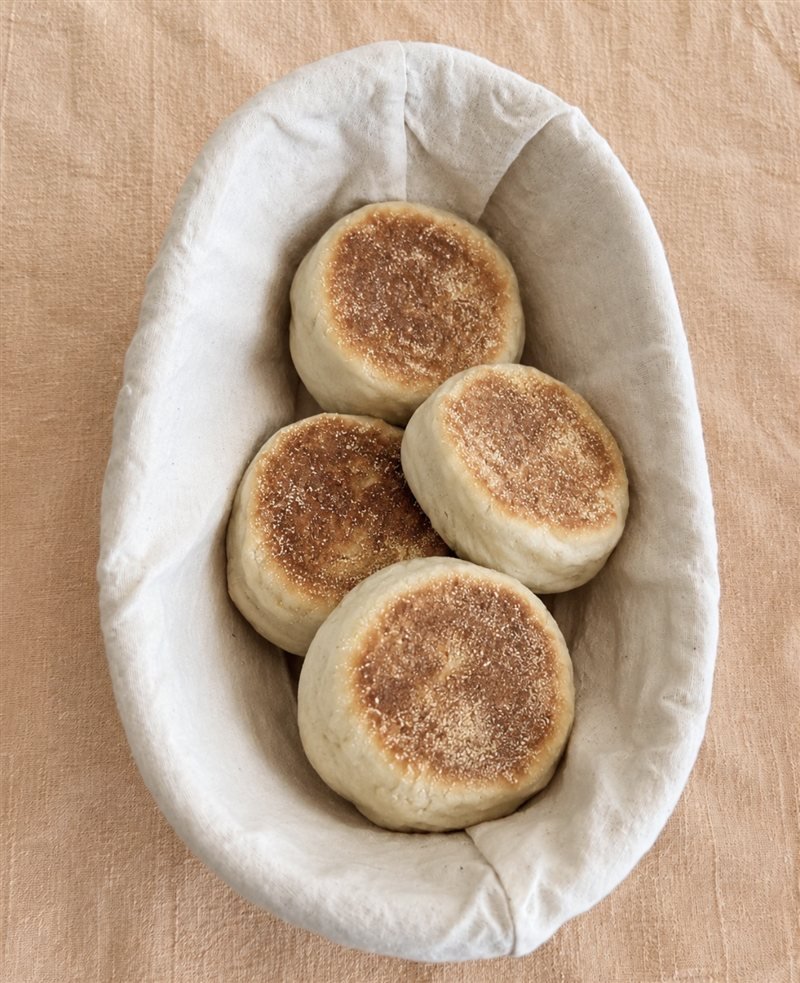
Nooks, crannies and a proper sourdough tang. These are griddled rather than baked, which is what gives an English muffin its flat top, pale sides and that open, craggy interior made for butter and jam. The dough is soft and enriched with milk and a spoon of honey, and the whole rise comes from a live starter.
A SHORT HISTORY OF THE ENGLISH MUFFIN
Despite the name, the English muffin as we know it was popularised in New York. Samuel Bath Thomas, who emigrated from Plymouth in 1874, opened a bakery and began selling a griddled yeast roll he split by hand rather than cutting, leaving the torn surface that traps butter. Back in England the same thing had been sold by muffin men for a century, carried through the streets on a tray and rung in with a bell.
What the early versions had that most supermarket muffins no longer do is time. Before commercial yeast was available, the rise came from a sour batter kept back from the day before. That is what this recipe returns to: a starter, a long ferment, and nothing else doing the lifting.
WHY THEY ARE GRIDDLED, NOT BAKED
An oven sets the crust before the inside has finished expanding, which gives you a roll. A griddle works from one side at a time at a much lower temperature, so steam keeps moving upward through the dough while the surfaces stay soft. That slow vertical push is what opens the crumb into the irregular holes you want, and it is why the tops stay flat and pale instead of doming and browning.
It also means you want the pan cooler than feels right. Around medium-low, roughly 300F, for about eight minutes a side. Too hot and you get a dark crust around a raw middle, because the heat never reaches the centre before the outside is done.
WHY SOURDOUGH SITS EASIER
Every loaf here starts with organic flour and a live sourdough starter, and the rise comes from wild yeast alone. That matters for more than flavour. Across the long ferment, the wild yeast and lactic acid bacteria work through a share of the flour’s starches and sugars before the dough ever meets the oven — effectively starting the digestion for you, which is why people who find ordinary bread heavy going tend to manage sourdough comfortably.
The same slow process reduces phytic acid, the compound in grain that locks up iron, zinc and magnesium, leaving more of those minerals available to your body. It is also what gives the loaf its keeping quality and its reputation for being kind to the gut — chocolate chips and all.
THE RECIPE
INGREDIENTS
- Levain — 15 g sourdough starter, 50 g organic all-purpose flour, 50 g water
- 100 g active levain, from above
- 240 g organic milk
- 20 g honey
- 360 g organic all-purpose flour
- 5 g fine sea salt
- 40 g cornmeal, for dusting
INSTRUCTIONS
- Build the levain. The night before, mix 15 g starter, 50 g flour and 50 g water. Cover and leave at room temperature 8 to 12 hours, until domed and bubbly.
- Mix the dough. Whisk 100 g of the levain with the milk and honey until dispersed. Add the flour and stir until no dry patches remain. Cover and rest 30 minutes.
- Add the salt. Sprinkle the salt over and work it in with the pinch and fold method until fully incorporated.
- Bulk ferment. Cover and leave 4 to 6 hours at room temperature, doing a set of stretch and folds every 45 minutes for the first 3 hours. The dough should look puffy and risen by about half.
- Shape. Turn out onto a surface dusted with cornmeal and pat to about 2 cm thick. Cut six rounds with a 9 cm cutter, gathering and re-patting the scraps once. Dust both sides with cornmeal.
- Proof. Set the rounds on a cornmeal-dusted tray, cover, and proof 1 to 2 hours until visibly puffed.
- Griddle. Heat a dry skillet or griddle over medium-low, about 300F. Cook 8 minutes a side, until deep golden and the sides spring back. The internal temperature should reach about 200F.
- Split by hand. Cool at least 30 minutes, then fork-split around the edge and pull apart. Never cut them with a knife, or you lose the nooks.
TIPS FOR SUCCESS
- Keep the pan cooler than you think. If the muffins colour before 6 minutes, lower the heat.
- A dry pan is correct. Oil fries the surface and closes the crumb.
- Cornmeal is not optional. It stops sticking and gives the characteristic gritty base.
- Do not re-roll the scraps more than once, or the last muffins will be tough.
- Let them cool before splitting. Warm muffins tear flat instead of craggy.
STORAGE
Keep in a paper bag or bread box at room temperature for up to 3 days. They stale quickly because they are lean and small, so for anything beyond that, split them first and freeze in a sealed bag for up to 3 months. Toast straight from frozen, cut side up, for the best texture.
FREQUENTLY ASKED QUESTIONS
Can I bake these instead of griddling them?
You can, at 375F for about 18 minutes, but they will come out closer to a soft roll. The flat top, pale sides and open crumb all come from the griddle.
Why are mine dense in the middle?
Almost always underproofing, or a pan that was too hot. The dough should look visibly puffed before it hits the griddle, and the centre needs time to reach about 200F without the outside burning.
Can I use milk alternatives?
Yes. Oat milk works best for softness. The muffins will be slightly less tender and a shade paler, and the nutrition figures on this page will no longer apply.
Do I have to use honey?
No. Sugar or maple syrup in the same amount works. The honey feeds the ferment slightly and helps the surfaces colour, but the muffins will be fine without it.
Made this recipe? We'd love to see it!
Share your bake on Instagram and tag us so we can celebrate with you.
Tag your photos with #GratefulBreadSCV
